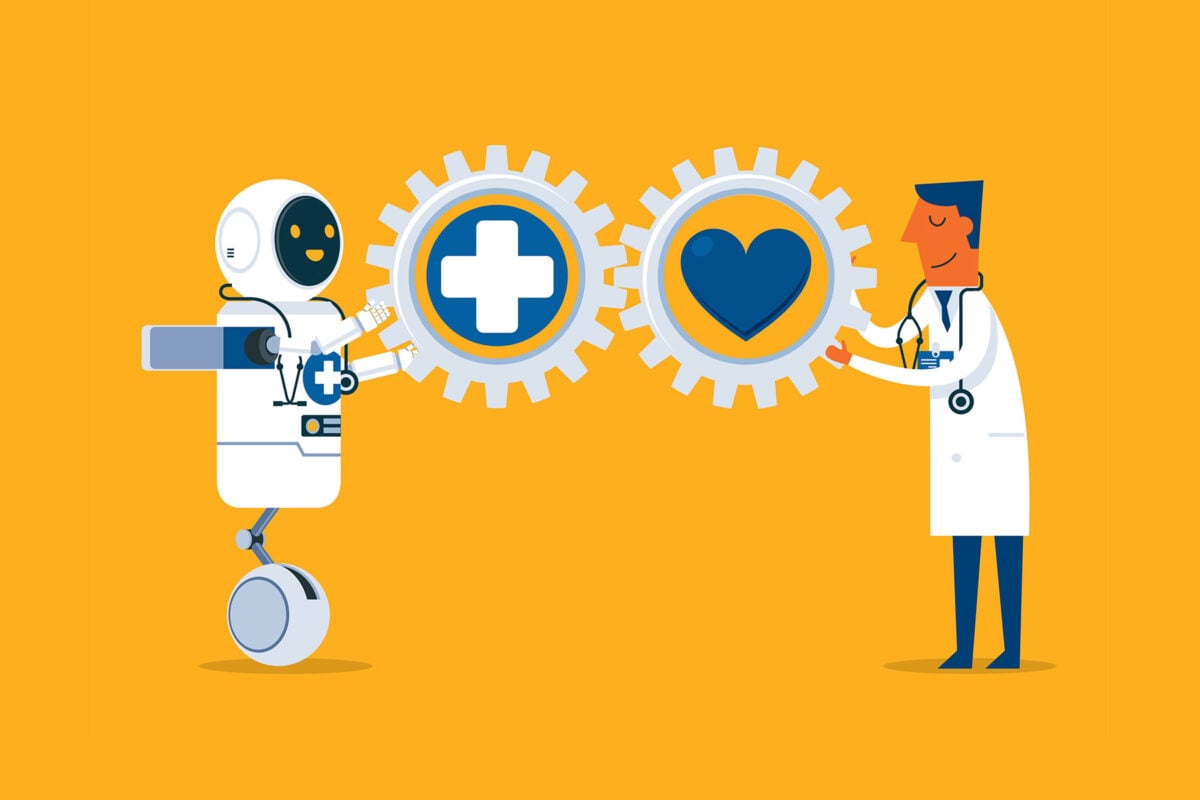
Here’s the paradox I’m willing to say out loud: The same AI tools promising to make healthcare marketing smarter are quietly making it easier to produce content that no one trusts.
I’m not arguing against AI. I am arguing for healthcare marketers to think carefully about what AI should and should not do in a category where trust is often the deciding factor between being noticed and being chosen.
Healthcare audiences are doing their fair share of independent research before they ever fill out a form or make a call. They’re comparing reviews, scanning for credibility signals, asking AI tools for guidance and expecting digital experiences to be clear, fast and useful. Meanwhile, I recognize healthcare marketers are under pressure to find ways to use AI to move faster, increase personalization and gain efficiencies. All excellent things to pursue. The tension between the two is real, though the opportunity is bigger: build a marketing model where AI scales relevance, while proof, transparency and human expertise build confidence.
Get that balance wrong and you’re producing more content than ever while watching people scroll past it.
Trustworthy is not a differentiator. Trust is.
For years, healthcare marketers have used trust as a brand attribute, something you claim in a tagline, demonstrate in a patient testimonial and call it done. In 2026, that’s not enough. Trust needs to function as a growth lever.
Trust influences whether someone books an appointment, switches providers, follows through on a referral, chooses a health plan or engages with a new care solution. It shapes how buyers move through longer, more complex B2B decision cycles too. A health system evaluating a medtech partner, a benefits leader vetting a digital health solution, a consumer comparing diagnostic options—none of them want a polished message. They want evidence.
That’s why generic claims are actively eroding credibility.
Patient-centered. Innovative. High-quality. These words may be true, but audiences have heard them so many times they register as noise. Trust in institutions continues to decline, while peer voices, proof points and demonstrated expertise grow in influence.
The brands that win aren’t the loudest. They’re the easiest to believe.
AI can write the content. People create the proof.
AI is changing how healthcare content is created, distributed and discovered, and the efficiency gains are significant. Marketing teams are using it to identify audience needs, accelerate content development, personalize journeys, summarize research and improve campaign performance.
But AI also creates new risk in a category that can’t afford it. Inaccurate or overly broad health information causes confusion and erodes confidence. And as AI-generated content floods every channel, audiences are already getting better at detecting content that feels vague, repetitive or disconnected from real expertise.
The standard has to be clear: AI supports the process. People supply the proof.
Used well, AI helps teams move from volume to relevance, surfacing common patient questions, identifying content gaps, segmenting audiences more intelligently and repurposing expert insights across channels. But the credibility still has to come from people: clinicians, researchers, care teams, patients, members and product experts. In an AI-driven environment, human validation can be a real brand advantage.
What questions do healthcare audiences ask before they trust you?
Healthcare decisions carry friction. Patients delay care because they’re uncertain what symptoms mean, worried about cost or skeptical that a provider will understand them. B2B buyers hesitate because implementation feels complex, stakeholder buy-in is shaky or the promised ROI is hard to verify.
What’s driving that friction, almost always, is an unanswered question. And your content is either answering those questions or leaving people to fill in the blanks themselves.
Here’s what your audience is actually thinking when they land on your content:
- Can I trust this?
- Is this right for someone like me?
- Has this worked for others?
- What evidence supports the claim?
- Who is actually behind this recommendation?
- What happens if I take the next step?
Strong content answers those questions before they become reasons to disengage.
- For patients, they find the answers in shared experiences from relatable influencers and advice from straight-talking doctors.
- For health systems, that means patient stories with real outcomes, physician profiles with genuine depth, and clear explanations of what to expect.
- For payers, it means member experience data, navigation support examples and cost transparency tools.
- For diagnostics and medtech brands, it means clinical validation, workflow impact, adoption data and peer perspectives.
The format matters less than the function. Strong proof content reduces hesitation. It moves people forward. It builds trust. And right now, most healthcare content is leaving that work undone.
How do you build trust into your content system?
Here’s what to do. Start with an audit. Pull up your highest-value web pages, campaigns and conversion paths. Gut check each one against these simple questions:
- Where are you asking audiences to believe a claim without giving them a reason to?
- Where are you using broad language instead of specific proof?
- Where would a patient, member, buyer or caregiver still feel uncertain after reading?
- Where is AI-assisted content doing the heavy lifting without clinical review, expert voice or real-world validation behind it?
A trust-building content system isn’t about producing more assets. It’s about making every asset more useful and more credible.
That means patient and customer stories that show real problems and real outcomes. Provider and expert content that makes clinical credibility visible. Educational pages that answer real questions in plain language. Case studies that connect claims to measurable results. Transparent messaging around AI, data use and human oversight.
The healthcare brands with that kind of strong infrastructure will be the hardest to displace.