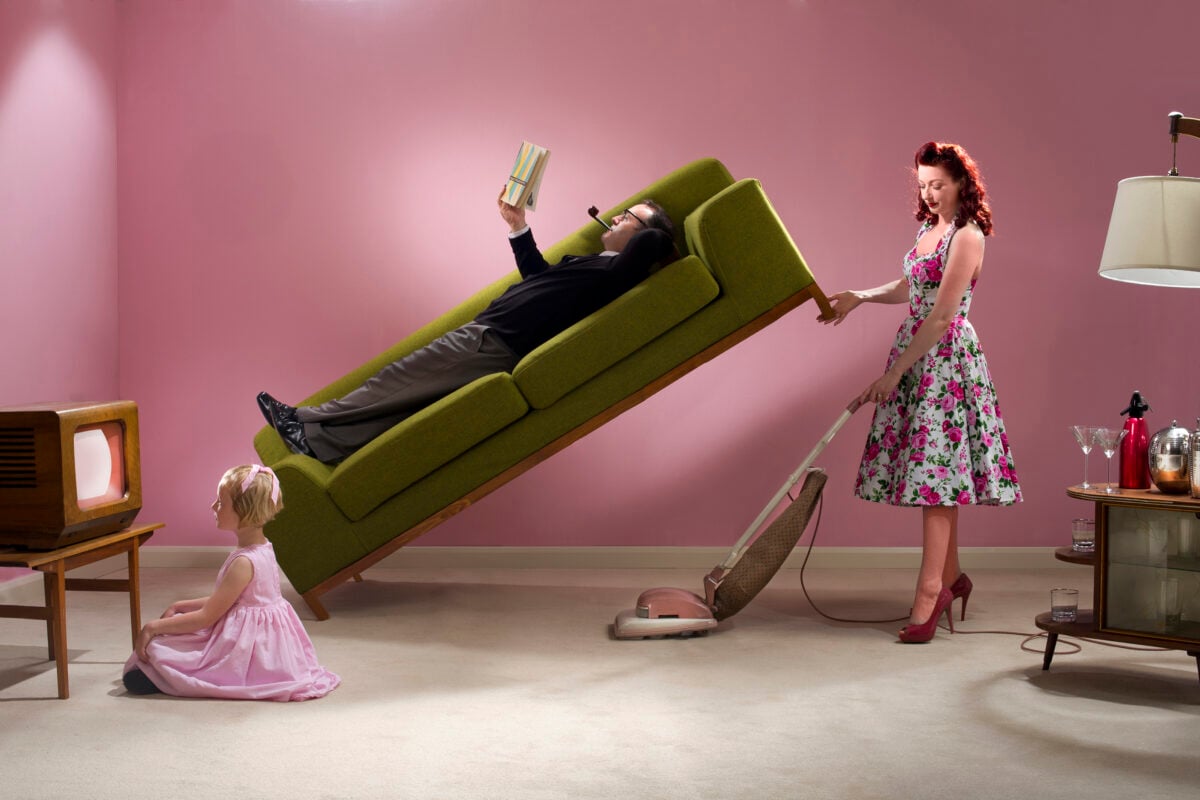
For many years, marketing to families followed a cookie-cutter formula. You start with an idealized version of family life—clean kitchens, happy kids, simple problems. You introduce a product that solves said problem. You wrap it in a polished, emotionally warm narrative. And it worked.
Until it didn’t.
What I see accelerating sharply in the past few months is a fundamental shift in how families live, how they make decisions and how they respond to brands. What used to resonate now feels detached at best and disingenuous at worst. It is clear that we are no longer operating in that outdated model.
But don’t think of it as an evolution. This is a reset.
The old model: Aspirational, polished, product-led
The traditional family marketing playbook was built on aspiration. It showed families as organized, harmonious and balanced.
The role of the brand was simple: step in as the solution. Remove friction. Make life easier. Deliver a better version of family life.
It was linear: Idealized family – problem – product – resolution.
And for a long time, it really did work because it aligned with cultural expectations. Parents were sold the idea that, with the right choices, they could get closer to “having it together.”
But that promise has eroded.
Not because families stopped caring or brands stopped delivering solutions, but because families changed the definition of what winning looks like.
The breaking point: When reality outpaced marketing
Today’s parents are navigating a complex landscape that’s never existed before:
- Constant digital noise
- Economic pressure and value scrutiny
- Growing awareness of mental load and emotional labor
- Ability to validate or disprove brand narratives quickly using social proof and influencers
They reject the idea that perfection is a standard to be attained. And more importantly, they’re talking about it openly, publicly and often in real time.
The result is a widening gap between how families are portrayed in advertising and how they exist in real life. That gap is where trust breaks.
Polished creative now feels outdated and disconnected. And in a category where trust is everything, that’s a big problem.
The new model: Real life, values and ecosystems
What’s replacing the old model isn’t a single tactic. It’s a fundamentally different approach to how brands show up in family life.
At its core, the new model looks like this:
Real family – shared values – ongoing engagement – product as enabler
Let’s unpack that.
1. From idealized families to real life
Families today don’t want to see perfection. They want to see themselves.
That means messy routines, competing priorities and honest moments of frustration and joy.
The shift toward imperfect parenting isn’t just a content trend, it’s a trust signal. It tells parents, you’re not alone in this.
The brands that are succeeding are setting aside beautiful content to produce more recognizable and resonant content.
2. From product benefits to shared values
Convenience is no longer a differentiator. It’s expected. What parents are actively evaluating now is:
- Does this align with how I want to raise my child?
- Does this support my family’s well-being?
- Does this help me feel like I’m making a thoughtful choice?
This is the rise of intentional parenting, and it’s reshaping purchase behavior.
Products are still important. But they’re being filtered through a values lens that consists of:
- Developmental benefits
- Emotional impact
- Long-term usefulness
In other words, the question transforms from Does this work? to Does this matter?
3. From campaigns to ecosystems
The old model was campaign driven. The new model is ecosystem driven.
Parents don’t make decisions at a single moment or on a single platform. Their journey is fragmented, iterative and influenced by multiple sources including:
- Social discovery
- Creator recommendations
- Peer validation
- Long-tail research
This means brands need to show up consistently, creatively and contextually.
This is where influencer partnerships, community-building and multi-platform storytelling come into play. Not as add-ons, but as a core infrastructure.
Consider how your brand builds trust over time, not in a single impression.
4. From selling products to enabling moments
One of the most important shifts we’re seeing is how families are prioritizing experiences over things.
They’re looking for:
- Connection
- Memory-making
- Shared rituals
The role of the brand is no longer to be the hero of the story. It’s to enable the moment. That’s a subtle but powerful shift. It moves messaging from buy this to make your life better to use this to create something meaningful.
Brands that create experiences drive emotional relevance with their audiences.
The hidden layer: Kids as co-decision-makers
There’s another dynamic shaping this new model—one that’s easy to underestimate. Kids, particularly Gen Alpha, are increasingly influencing household decisions. They’re exposed to content. They have preferences. They participate in the conversation. This means family marketing is no longer a single-audience strategy.
It’s a dual (and sometimes triple) audience challenge:
- The parent (rational decision-maker)
- The child (emotional influencer)
- The broader social context (peer and creator influence)
Brands that understand the co-decision dynamic and design for it have a significant advantage.
What this means for family-focused marketers
If the model has changed, the implications are clear.
- Creative needs to feel lived-in, not produced: This doesn’t mean lower quality. It means higher authenticity.
- Strategy needs a point of view: Neutral brands are increasingly invisible. Parents are choosing brands that stand for something, even if it’s simple.
- Media planning needs to reflect real behavior: Linear funnels don’t map to how families make decisions anymore.
- Partnerships matter more than placements: Creators and communities are more than channels—they’re trust engines.
- Products need a narrative beyond function: If you’re only communicating features, you’re competing on the least differentiated layer.
Where family-focused brands go from here
What makes this moment particularly interesting is that we’re still early in it. It’s not too late for brands to fully embrace this reset, not just in messaging, but in mindset.
Go beyond swapping out creative. Think about this reset as a moment to redefine the role your brand plays in family life.
Families are actively looking for brands that:
- Understand their reality
- Reflect their values
- Support their intentions
That’s a higher bar than a simple problem solve, but it’s also a more meaningful one. For the brands willing to meet parents there, the reward goes way beyond attention. It’s the hard-to-get stuff: trust, relevance and, ultimately, brand loyalty that extends well beyond a single product purchase.
The old model made brands look good. The new model makes families feel understood. And right now, that’s what matters most.